.gif)
Why 2026 Is the Year You Should Redesign Your Website
If your website is feeling a little tired, slow or just not giving main-character energy anymore, you’re not alone. Across nonprofits, brands and cultural organisations, 2026 is shaping up to be a massive reset year for digital. New tech, new standards and new audience habits are forcing teams to rethink their platforms from the ground up.
We at HLabs spend a wild amount of time inside other brand, publisher and agency websites. We see the patterns. We see the pain points. We also see the opportunity. So here’s a quick look at what’s driving the 2026 redesign wave and how you can tell if it’s your turn.
Websites don’t age gracefully
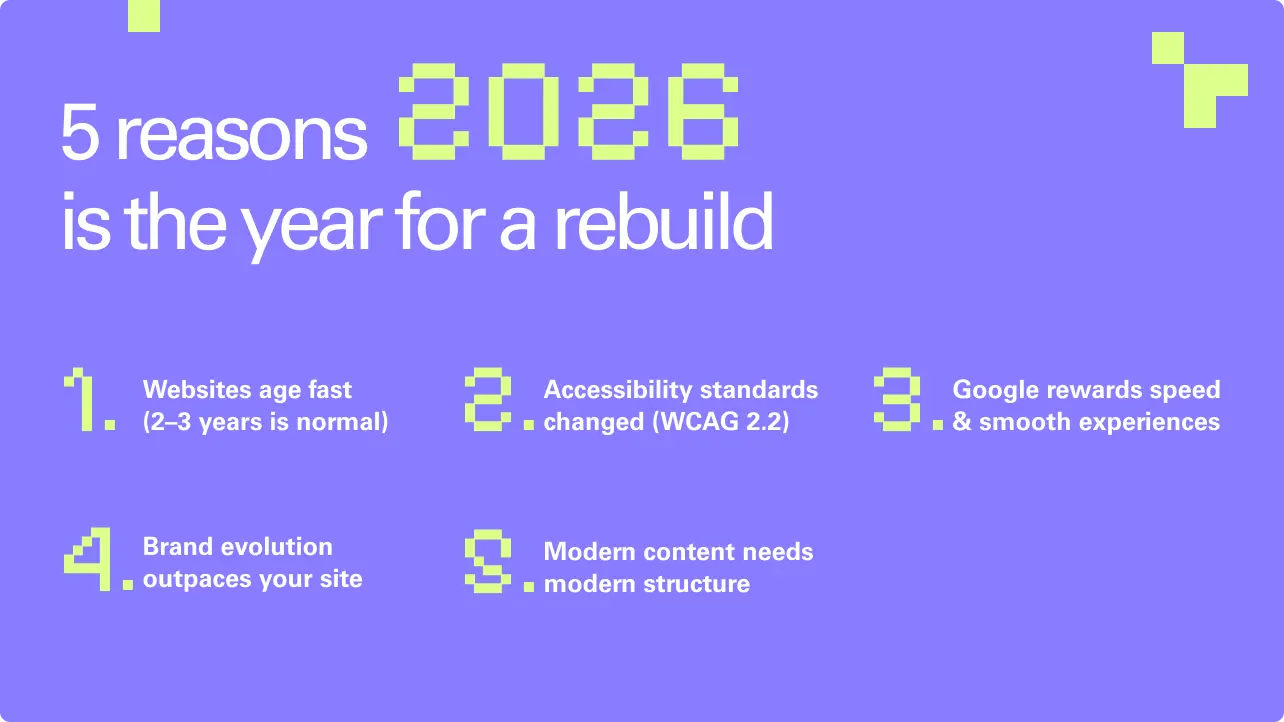
The average website lifespan is just over two years. Touch three years and the cracks start showing. Touch four and you’re basically living in the digital equivalent of a flip phone.
Recent studies show:
- Websites last around 2 years and 4 months on average
- 68 percent of nonprofits redesigned their site within the last three years
- Most organisations refresh their site every 2 to 3 years to keep pace with users
If your website was launched in 2020 or 2021, it is officially entering its “it’s not you, it’s the CMS” stage. Performance dips. UX feels dated. The brand evolves but the site stays stuck in time. You don’t need a teardown to know the foundations need love.
Accessibility standards just changed
WCAG 2.2 became an official standard last year and it introduces nine new criteria that affect navigation, focus, target sizes and how people log in or interact with forms. If your site still clings to older WCAG versions, you are probably missing compliance markers.
This is especially important for anyone who wants their digital experience to actually reflect their values. Accessibility audits are already prompting full rebuilds because retrofitting older sites is often more painful than starting fresh.
Google continues to reward fast, smooth experiences
Core Web Vitals are not going away. Google has confirmed that page experience metrics influence rankings and are an important quality signal. If your site is slow, jumpy or takes a small eternity to load on mobile, your reach will feel it.
What we hear most from teams is a version of: “Everything feels heavier than it should. Updating content is annoying. Our Lighthouse score is yelling at us.”
None of that magically fixes itself. In many cases, a rebuild is the most cost-effective way to modernise the stack, simplify the CMS and get your SEO back in good shape.
Your brand probably evolved. Your site might not have.
A lot of organisations refreshed their identity, tone or creative direction over the past two years. But the website often gets left behind because teams are too busy to tackle the rebuild.
Then suddenly everything feels inconsistent. Social looks new. Campaigns look new. Your homepage looks… pre-pandemic vibes.
If your brand story evolved but your site still speaks in your old voice, you are not just missing aesthetic cohesion. You are missing growth. Your website is your most visible touchpoint. It deserves to look like your organisation today, not your organisation three redesign cycles ago.
Modern content requires modern structure
In 2026, visibility doesn’t stop at Google. Your audience is just as likely to find you through AI-powered search tools like ChatGPT, Perplexity, Copilot, or Gemini — and these systems don’t browse your website, they interpret it.
If your site can’t speak AI, it won’t be heard. Content that isn’t structured and machine-readable simply doesn’t surface in the new discovery layer.
Welcome to the structured content era. AI search, modular publishing, multi-channel storytelling and longform editorial can’t live on websites built for static pages and one-off blog posts.
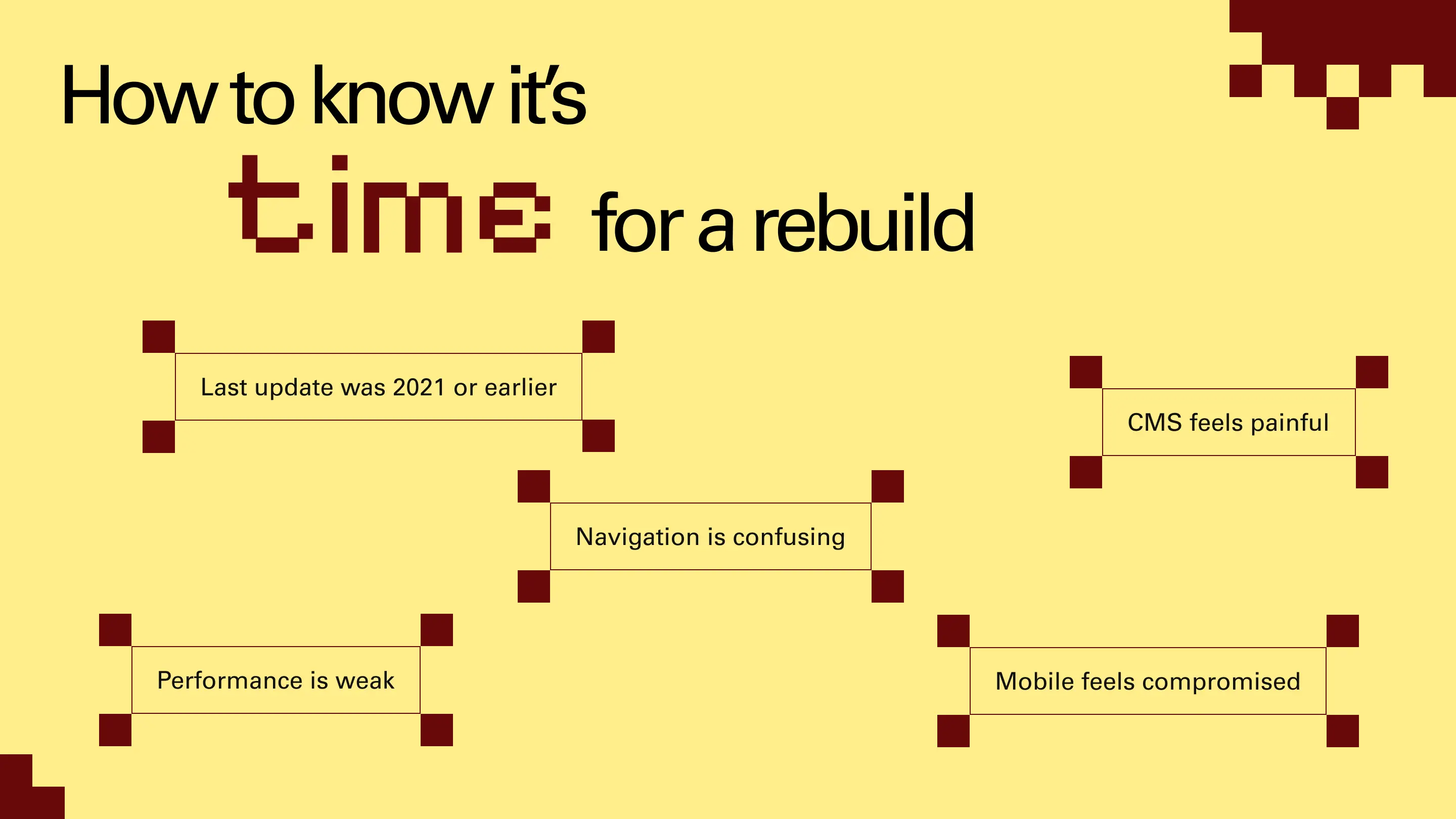
So how do you know if it’s time?
Here are the signs we spot again and again:
- Your CMS feels like it's fighting you
- Your site’s last major update was 2021 or earlier
- Your performance score is weak
- Your navigation is confusing or overstuffed
- Mobile feels compromised
- Your brand no longer matches your digital presence
- You are planning a big campaign or strategic refresh in 2026
If you feel even two of these, your site is ready for an upgrade.
What’s a Rich Text element?
The rich text element allows you to create and format headings, paragraphs, blockquotes, images, and video all in one place instead of having to add and format them individually. Just double-click and easily create content.
Static and dynamic content editing
A rich text element can be used with static or dynamic content. For static content, just drop it into any page and begin editing. For dynamic content, add a rich text field to any collection and then connect a rich text element to that field in the settings panel. Voila!
How to customize formatting for each rich text
Headings, paragraphs, blockquotes, figures, images, and figure captions can all be styled after a class is added to the rich text element using the "When inside of" nested selector system.


We help teams turn outdated, rigid websites into story-driven digital experiences built on clarity, accessibility and performance. Whether you want a quick website health check, a mini audit or a gut-check conversation about where to start, we are here. Let’s make your 2026 site something you are genuinely excited to share.

We’ll show ours if you share yours.
Share your details so we can stay in touch and directly show you premium HLabs content!